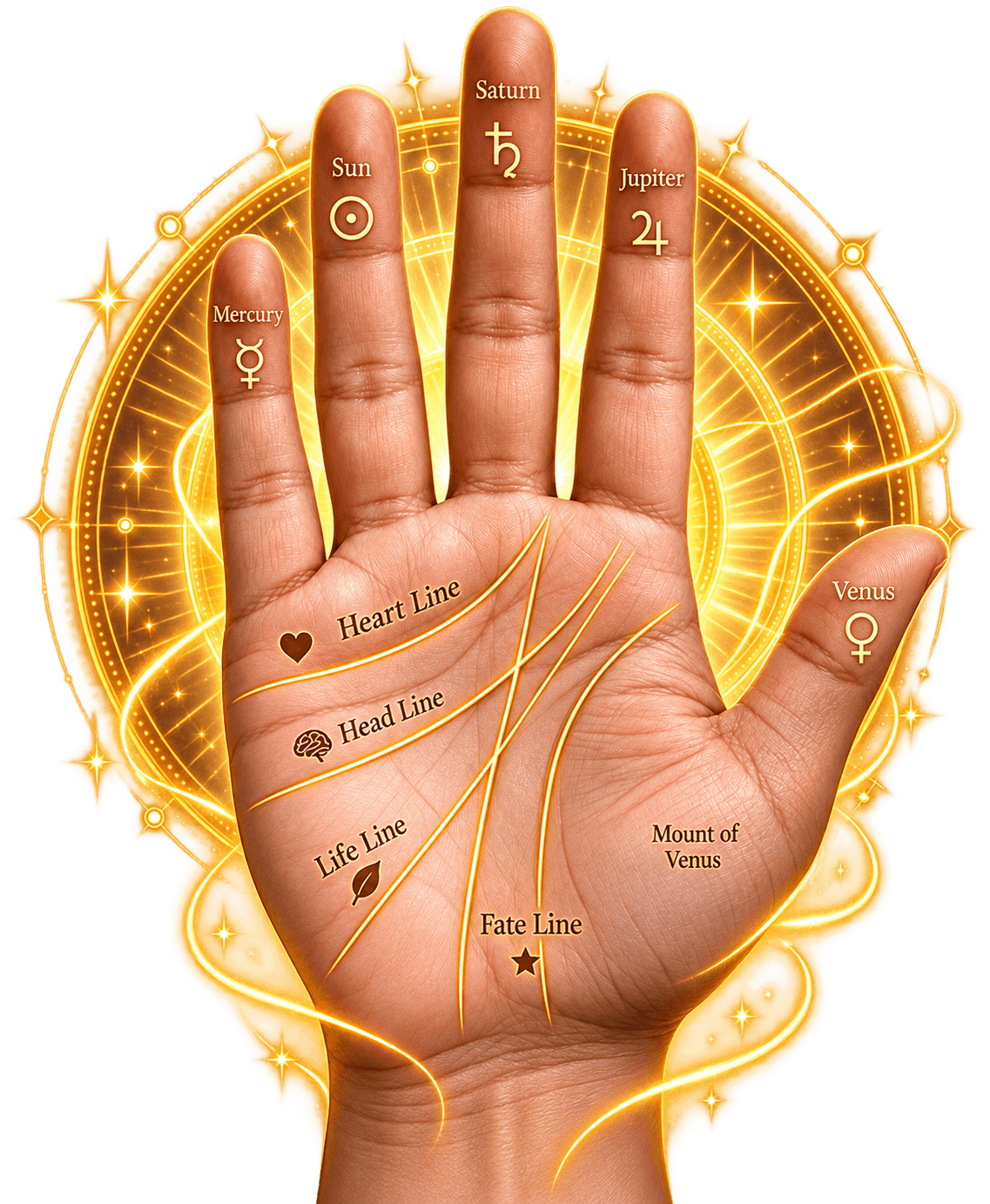
✦ Which hand to read in palmistry
Which Hand To Read — Left, Right, Or Both Together
अद्यतन 17 Oct 20267 मिनट पढ़ेंहस्तरेखा AI मुफ़्त और नियम-आधारित हस्तरेखा गाइड प्रकाशित करता है — हर पेज पहले शास्त्रीय अर्थ बताता है, फिर आपकी रोज़मर्रा की ज़िंदगी के लिए उसका मतलब।
छोटे में
Which hand to read in palmistry is the first question every beginner asks — and the useful answer is that you read both, with different jobs. The active hand (the one you write with) is read for what is happening now and where your choices are taking you. The passive hand is read for the pattern you were born into.
The left-right rule is often repeated wrongly as 'males this way, females that way'. Classical Indian texts did use fixed sides, but modern readers replaced that with one clean logic: active hand equals present and personal effort, passive hand equals inheritance and early conditioning. That single rule covers every reader correctly, whatever their dominant hand is.
Below: the active-passive rule in detail, how left-handed readers change the picture, how to compare the two hands line by line, the old gender convention explained honestly, common mistakes, and which hand to photograph for an AI reading.
हस्तरेखा में कौन सा हाथ पढ़ा जाता है?
Short answer: both. The reading is a comparison, not a lookup. You look at the same feature — say the life line or the mount of Venus — on both palms, and the difference between them carries the message. Where the two hands match, the trait is settled and sturdy. Where the active hand is stronger, the person has improved that area through their own effort.
The reverse difference is just as useful: a line that is bright on the passive hand and faded on the active one is read as an ability that exists but has not been exercised — a talent waiting for use. This comparison is the single most valuable habit a beginner can build, and it is why honest readers ask for both palms.
Left hand aur right hand: किसका क्या मतलब है
The rule maps cleanly once you stop asking 'left or right' and start asking 'which hand is active'. People are born with roughly the same palm; life writes on the working hand. Everything a teacher needs follows from that.
Right-handed reader
Left palm is passive (born pattern), right palm is active (present life and choices).
Left-handed reader
The roles flip: right palm is passive, left palm is active. Same logic, mirrored.
Trained both hands
Readers treat the hand you use for fine work — writing, cooking, tools — as the active one.
Temporary switch
After injury or training a new habit, the newly used hand becomes the present-life record.
दोनों हाथों की तुलना: बदलाव कैसे पढ़ें
Pick one feature at a time and compare like with like: the life line's depth, the head line's slope, the heart line's end, the fate line's start. A stronger line on the active hand is growth — the person has worked on that area. A fading line on the active hand is the pattern asking for attention, not a punishment. Identical lines on both hands mean the trait is deeply settled.
Old teachers gave one more rule: compare direction before you compare depth. A line that rises higher on the active hand is progress in that area even if it is thinner; a line that drops lower is strain, even if it looks dark. Direction is ambition or fatigue; depth is the amount of energy in the trait.
पुरानी परंपरा: पुरुष और महिला के लिए अलग हाथ?
You will still meet the claim that women should show the right hand and men the left, or vice versa depending on which old book is quoted. That convention comes from an era when hands were read during fixed social roles, and the books do not even agree among themselves. The active-passive rule replaced it precisely because it needs no gender.
For an honest reading, the practical sequence is fixed: first the active lion's share of attention, then the passive hand for contrast, then any kundli details if the reader also does astrology. Anyone who refuses to look at both hands for a gender reason is following ritual, not reading.
आम गलतियाँ जो पहला निष्कर्ष बिगाड़ देती हैं
Reading one hand and calling it done is the classic mistake — half the message lives in the difference. The second is comparing left with right at different times of day or under different light, where a pale line on one palm looks absent next to a clear one. Photograph both in the same light, then compare.
The third mistake is reading the passive hand's lines as current facts. The born pattern is background, not news. A soft, wide-open passive hand with a hard-working active hand describes a person who entered life easy and built discipline — two true statements, one story.
AI reading के लिए फ़ोटो: किस हाथ की लेनी है?
For studio-quality readings you would normally show both palms. For a photo-based AI reading, one clear palm photo is enough to start: open the active hand fully, fingers relaxed, light coming from behind the camera, palm filling the frame. The reading engine reads the lines, mounts and signs from that image.
If your training is already serious, read this page beside the learn-palmistry course and the sign guide — the method of comparison you just read is the same one every deeper page assumes. Then upload a palm photo and let the AI do the two-hand arithmetic for you.
अक्सर पूछे जाने वाले सवाल
छोटे और सीधे जवाब — यही सवाल पाठक रोज़ पूछते हैं।
Which hand should I read in palmistry?
Read both: the active hand — the one you write with — shows your present life and choices, while the passive hand shows the born pattern. The interesting message is the difference between them. Where the two agree, the trait is settled; where the active hand is stronger, the person has grown that area by effort.
I am left-handed — which hand is my active hand?
For a left-handed person the roles simply flip: the left palm is the active hand and the right palm is the passive one. The logic is identical — active hand equals present life and personal effort, passive hand equals early conditioning. The reading mirrors itself; nothing else changes.
Why do palmists ask for both hands?
Because a single hand only gives half the sentence. The passive hand shows where you started; the active hand shows where you have taken it. Comparing the same line across both palms tells the reader what has changed and what is naturally settled — something one palm alone can never show, however deep its lines look.
Do men and women have different hand-reading rules?
Old texts used fixed sides by gender, but those books disagree with each other and came from a rigid social era. Modern reading uses the active-passive rule instead, which needs no gender at all. For any honest palmistry question, both palms are read and compared — no reader worth trusting refuses a hand for gender reasons.
Which hand's photo should I upload for an AI palm reading?
One clear photo of your active palm is enough to start: open the hand fully, fingers relaxed, light behind the camera and the palm filling the frame. If you can, add the passive hand too — the engine reads both and compares, and the comparison is where the reading gets personal.
अपनी हथेली पढ़वानी है?
अपनी हथेली की फ़ोटो अपलोड करें और AI से मुफ़्त रीडिंग पाएँ — राशि, नक्षत्र और हाथ की हर प्रमुख रेखा, हिंदी और English में।
आगे पढ़ें
इसी विषय की चुनी हुई गाइड।
हस्तरेखा एक पारंपरिक विश्वास और मनोरंजन आधारित मार्गदर्शन है — इसे चिकित्सा, कानूनी या वित्तीय सलाह की जगह न लें।
Life line · Head line · Heart line · Fate line · Sun line · Money line · Marriage line · Health line · Children line