✦ Palmistry vs astrology
Palmistry vs Astrology — The Real Difference And When To Use Each
अद्यतन 17 Oct 20266 मिनट पढ़ेंहस्तरेखा AI मुफ़्त और नियम-आधारित हस्तरेखा गाइड प्रकाशित करता है — हर पेज पहले शास्त्रीय अर्थ बताता है, फिर आपकी रोज़मर्रा की ज़िंदगी के लिए उसका मतलब।
छोटे में
Palmistry vs astrology is a fair question with a clean answer: they look at the same life from opposite ends. Astrology reads the sky at birth — a fixed chart that describes the road you were given. Palmistry reads the hand in the present — a living record that keeps updating as you walk the road.
That one difference explains everything else: why astrologers need your birth time and palmists do not; why a kundli stays the same for life while a palm's fine lines shift; and why Indian families traditionally use both — kundli for timing and muhurat, hand for nature and verification.
This page lays both systems side by side, marks their honest limits, and shows where they strengthen each other — including how a modern AI reading combines rashi and nakshatra from your details with the lines from your palm photo.
दोनों में बुनियादी फर्क
Astrology is a time-based system: birth date, time and place fix a chart of nine planets in twelve houses, and its predictions run on periods (dasha) and transits. Palmistry is an observation-based system: the hand shows the present condition of traits — depth of vitality, direction of career, style of emotion — with time zones seen as proportions, not hours.
Practical feel of the two: astrology answers 'when and what period'; palmistry answers 'how and how much of it is you'. A kundli told the family a tough phase was running; the palm showed the person had already built the discipline to absorb it. Two instruments, two readings of the same room.
ज्योतिष क्या देखता है: कुंडली, ग्रह और दशा
A birth chart records the sky in twelve rooms: personality, wealth, siblings, home, education, work, partnership, transformation, belief, career, gains, loss. Its strength is timing: dasha periods and planetary transits give long arcs — 'this is a Saturn stretch', 'Jupiter returns to your house of work next spring'. Its limit is that the chart only knows the setup, not the person's current skill.
In Indian practice the kundli also runs family matters — matching, muhurat, rituals — which is why it is the elder system at home even where palmistry is the reader's craft. Both are traditional systems of interpretation; neither is a science, and honest practitioners of both say so.
हस्तरेखा क्या देखती है: रेखाएँ, पर्वत और चिह्न
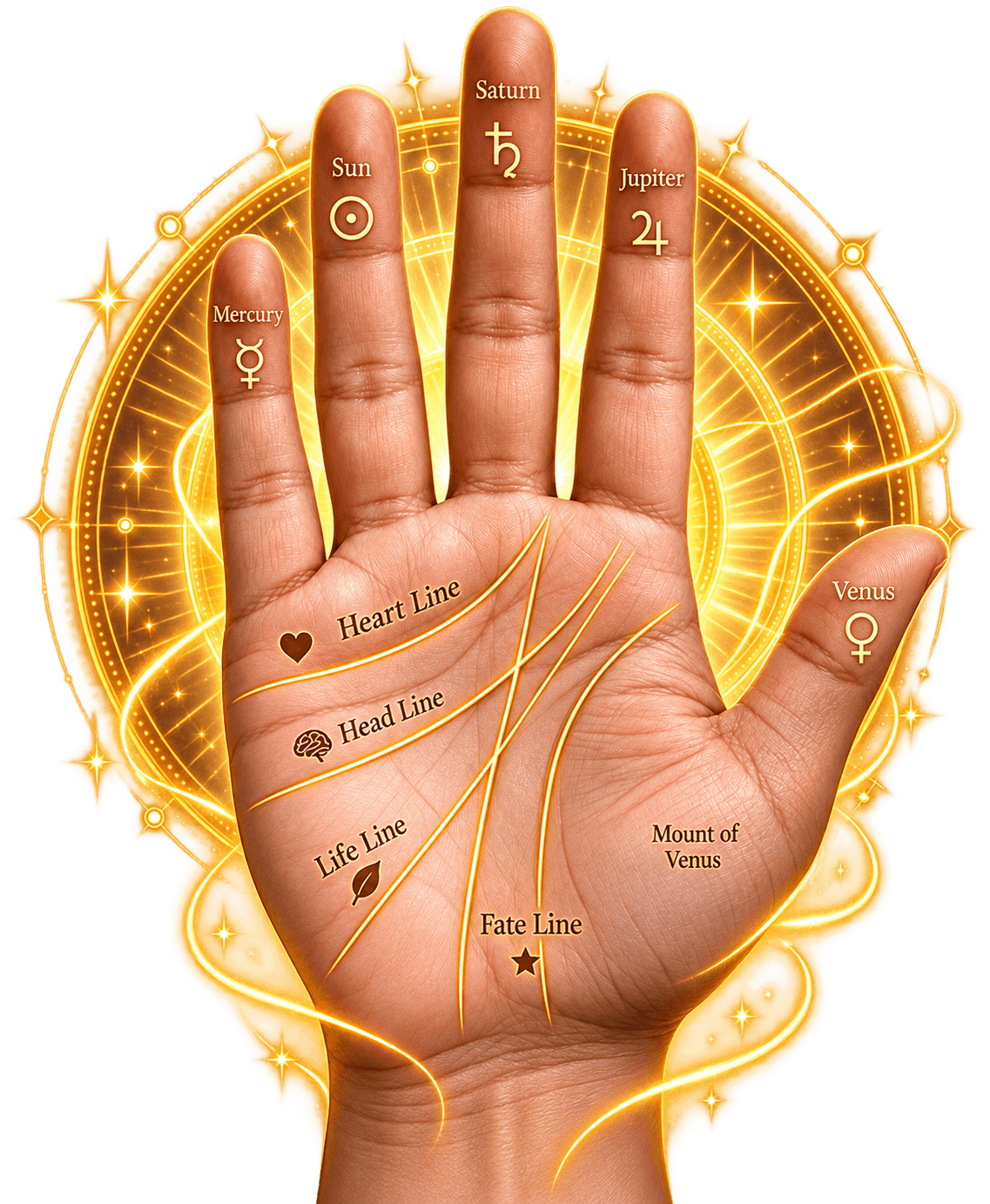
The palm shows proportions: how much vitality (life line's depth), how the mind organises itself (head line's course), how the heart commits (heart line's end), how much direction is fixed (fate line). Mounts add texture — ambition, duty, recognition, trade, family, imagination, courage — and signs punctuate specific themes.
The palm's special strength is the active-passive comparison: it can show change. A trait that began light on the passive hand and deepened on the active hand is visible growth — the exact thing a fixed birth chart cannot record. That is why traditional Indian reading recommends the hand as the check after any astrological statement.
दोनों साथ में: कब कौन सा देखें
The working rule old families used is really a division of labour. Muhurat, matching, ritual timing — kundli's desk. Nature, stamina, how a person will carry a phase — the hand's desk. When both speak about the same thing and agree, confidence is reasonable; when they disagree, the palm reads the present and the chart reads the period, so both can be true at once.
This is exactly how the AI reading on this site combines them: your birth details generate rashi and nakshatra for the timing layer, the palm photo gives the lines and mounts for the nature layer, and the report presents them together — with the same honest caveat every serious practitioner keeps: these are traditional guides, not guarantees.
साफ़ बात: न विज्ञान, न बेकार
Two honest sentences about both systems. First: neither astrology nor palmistry has survived scientific testing as a predictor, and anyone claiming lab-grade proof is selling something. Second: both have survived centuries as mirrors — structured ways families talk about fear, timing and temperament.
Used as mirrors, they are genuinely useful: they slow a decision down, they ask what you already know about yourself. Used as receipts — 'stay home on Tuesday because the chart says so' — they cost money and time. The line between the two uses is drawn by the reader, which is why an honest one is worth driving far for.
अक्सर पूछे जाने वाले सवाल
छोटे और सीधे जवाब — यही सवाल पाठक रोज़ पूछते हैं।
Palmistry vs astrology — which is more accurate?
Neither is accurate as a prediction science, and honest practitioners of both say so. Astrology structures time — periods and timing; palmistry structures nature — traits and tendencies. Which feels 'more right' in a reading usually reflects the reader, not the system.
Can I use both palmistry and astrology together?
Yes, and Indian tradition has always done so: the kundli for timing, muhurat and matching; the hand for nature, stamina and confirmation. When both agree, an observation gets more confidence. When they differ, treat the chart as the period and the palm as the present condition.
Which comes first — hand reading or kundli?
For a question about nature and readiness, start with the hand: it shows the current condition. For a question about timing — marriage phase, job change window, muhurat — start with the kundli. Serious readers usually finish by checking the first answer against the second before saying anything final.
Why do palm lines change but the kundli does not?
Because they record different things. The kundli is a snapshot of the sky at one moment — fixed forever. The pali is a living surface: skin, work and habits re-draw the fine lines over years. That is also why readers check the active hand for change — the palm is the system that updates.
How does the AI reading use both systems?
Your birth details generate the rashi and nakshatra layer; your palm photo is read for the lines, mounts and signs layer. The report merges them into one reading across the major life areas and keeps the honest limits visible throughout — traditional guidance, never medical, legal or financial advice.
अपनी हथेली पढ़वानी है?
अपनी हथेली की फ़ोटो अपलोड करें और AI से मुफ़्त रीडिंग पाएँ — राशि, नक्षत्र और हाथ की हर प्रमुख रेखा, हिंदी और English में।
आगे पढ़ें
इसी विषय की चुनी हुई गाइड।
हस्तरेखा एक पारंपरिक विश्वास और मनोरंजन आधारित मार्गदर्शन है — इसे चिकित्सा, कानूनी या वित्तीय सलाह की जगह न लें।
Life line · Head line · Heart line · Fate line · Sun line · Money line · Marriage line · Health line · Children line