✦ Hast Rekha Palmistry
Hast Rekha Palmistry — Hatheli Padhne Ka Poora Guide
अद्यतन 17 Oct 20269 मिनट पढ़ेंहस्तरेखा AI मुफ़्त और नियम-आधारित हस्तरेखा गाइड प्रकाशित करता है — हर पेज पहले शास्त्रीय अर्थ बताता है, फिर आपकी रोज़मर्रा की ज़िंदगी के लिए उसका मतलब।
छोटे में
Hast rekha palmistry ek traditional vidya hai jo hatheli ki lines (rekha), ungiyon, pav (mounts) aur chinhon ko dekh kar insaan ka swabhav aur zindagi me hone wale badlav samajhti hai. Is guide me aap jaanege kaun si line kahan hoti hai, har rekha ka matlab kya hai, aur bina kisi bhari kitaab ke khud apni hatheli kaise padhe.
Palmistry is not a magic key to the future. Think of it as a weather map of your habits: it shows tendencies, timings and directions you can work with. Nothing here is a guarantee, and nothing here replaces a doctor, lawyer or financial adviser.
On this page you will meet all nine classical lines once, then every guide opens a single line in depth — line kahan shuru hoti hai, kaisi line shubh maani jaati hai, aur usko roz ke jeevan se kaise jodein.
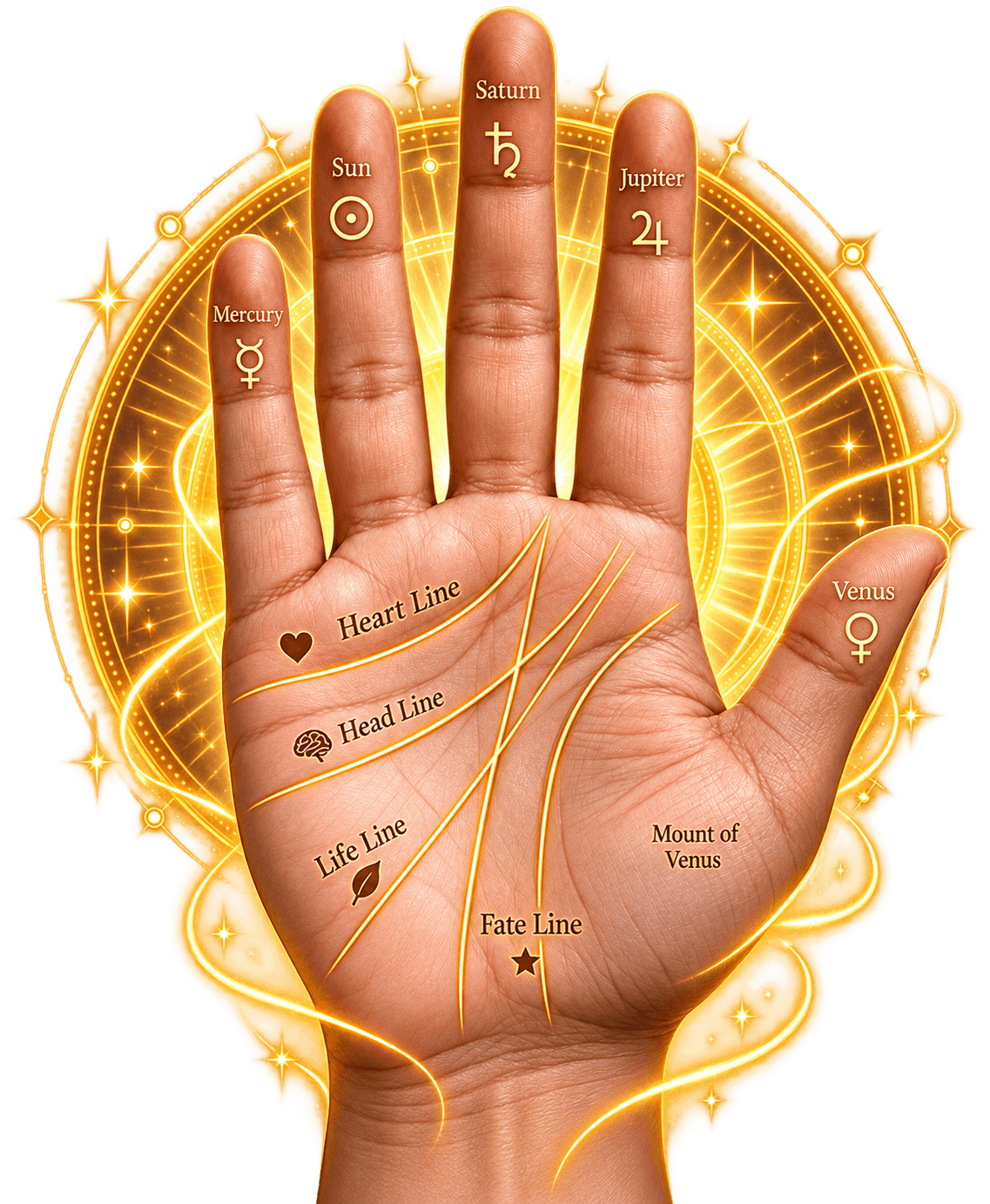
Nine lines, one palm: numbers match the list below. Every line has its own detailed guide on Hastrekha AI.
इस गाइड में शामिल नौ रेखाएँ — किसी भी रेखा पर नीचे टैप करके विस्तार से पढ़ें।
1. What is hast rekha palmistry? (Palmistry explained)
Hast rekha palmistry (also written hastrekha, hast rekha shastra or simply palmistry) reads four things together: the lines, the mounts (raised pads at the base of each finger), the fingers — especially the thumb — and the small signs like crosses, stars and triangles. A palmist does not read one line in isolation; the meaning comes from how the lines sit against each other.
That is why two people with a 'broken fate line' can have very different readings: the head line, the mount of Saturn and the overall strength of the hand change the story. In this guide, every time we describe a line we also tell you what to check next to it.
Hastrekha analysis is useful when you keep it practical: it points at tendencies — patience, money habits, communication style, relationship patterns — and those are things you can actually act on this month.
2. From Samudrik Shastra to AI: the journey of hastrekha vigyan
India's Samudrik Shastra (the science of reading body marks) is thousands of years old, and palm reading travelled with traders to Greece, Arabia and Europe. In the West, Cheiro and William Benham standardised the modern names we still use — heart line, head line, life line — while Indian tradition kept its own vocabulary of rekha, parvat and chinh.
Today software can measure a line's length, breaks and forks in seconds. What machines cannot do is judge context — that still needs interpretation. Hastrekha AI stays honest about this: the calculation is rule-based and classical, the report is written so a beginner can follow it, and AI tools were used only to build the website, not to invent your future.
3. How many lines are there? Different lines in palmistry
Classical palmistry talks about nine main lines, and that is the set this guide follows. Four of them you have certainly seen on your own hand; the other five are lighter and appear clearly only on some palms.
1. Life line (jeevan rekha)
Energy, vitality and the amount of change in a life — never a death date.
2. Head line (mastishk rekha)
Thinking style — logical or imaginative, quick decisions or deep study.
3. Heart line (hriday rekha)
Emotional style, love language and how you handle relationships.
4. Fate line (bhagya rekha)
Career direction, sense of duty and how much you build by yourself.
5. Sun line (surya rekha)
Recognition, creativity, fame and public respect.
6. Money line (dhan rekha)
Earning routes and money habits — how wealth arrives, not how much.
7. Marriage line (vivah rekha)
Attachment style and the timing of serious partnerships.
8. Health line (swasthya rekha)
Recovery power and stress signals — always with a medical disclaimer.
9. Children line (putra rekha)
Family growth in the classical reading — read gently, never as a verdict.
4. The four lines everyone has
The life line curves around the base of the thumb and speaks about your energy and how often life reshapes around you. A long, clear sweep is read as stamina; a broken one as a phase of change — not a short life.
The head line runs across the middle. Where it ends is the interesting part: under Apollo it suggests a practical mind, sloping towards the Moon it suggests imagination and languages. The heart line sits above it, and how close the two sit shows the balance between feelings and logic.
The fate line climbs from the wrist towards the middle finger. It is not 'luck' in a lottery sense — it is your sense of direction and duty. Many hands have a faint one, and that simply means the person builds their path through choices rather than an inherited track.
5. Seeing the lines on your own palm (diagram)
Keep your palm open under a bright light, fingers relaxed. The three deepest grooves are almost always the life, head and heart lines. Trace each one with a finger before you judge it — you are looking for depth, colour, breaks and small branches, not just length.
Photograph your palm flat, from directly above, in daylight — that same photo is what an AI palm reading uses. Shadows and angles are the biggest reason a reading looks wrong.
6. Mounts and fingers: the second half of a reading
Mounts are the raised pads under each finger — Jupiter (under the index), Saturn, Apollo (ring finger) and Mercury (pinky), plus the Moon on the outer edge and Venus at the base of the thumb. A full mount strengthens the line above it; a flat one quietly mutes it.
The thumb shows how you decide and how you hold your ground. A long, straight thumb is read as firm judgement; a very flexible thumb as easy adjustment. Fingers that curve gently towards each other suggest a careful, self-checking nature.
7. A five-step reading you can finish today
Start with structure, then add detail. Most beginners jump straight to 'what will happen' and get confused; the order below keeps a reading honest.
Step 1 — Pick the right hand
In Indian practice the active hand shows the present, the passive hand the inherited pattern. Read both, compare.
Step 2 — Map the four main lines
Life, head, heart, fate. Note depth, colour and where each one ends.
Step 3 — Look at the mounts
Which pad is fullest? That area of life is where your energy naturally goes.
Step 4 — Read the signs
Crosses, stars, squares, islands — each one changes the strength of the line it sits on.
Step 5 — Compare over time
Lines change slowly. Photograph your palm every six months and compare — that is real practice.
8. What palmistry can say — and what it cannot
Palmistry is good at patterns: how you handle money, whether you burn out, what kind of work suits your temperament, how you behave in close relationships. It is not good at exact dates, medical diagnosis or legal outcomes.
Be wary of anyone — human or app — who predicts death, divorce or disaster with certainty. Classical texts never do that, and honest readers talk about tendencies and choices instead.
9. Palmistry and your kundli together
A kundli describes the sky at your birth minute; the palm describes the person living that life. Read together, the birth chart gives timing — dasha and gochar periods — while the palm shows how a person is likely to respond inside those periods.
Hastrekha AI follows the same logic: one form, two readings — palm lines from your photo and Rashi, Nakshatra, Lagna and dasha from your birth details.
10. Get your own palm read free
Upload a clear palm photo (or just type your birth details) and Hastrekha AI builds the full reading in under a minute — every major line, the twelve life areas, lucky years and simple remedies, in Hindi and English. The on-screen reading is free; there is no login wall.
अक्सर पूछे जाने वाले सवाल
छोटे और सीधे जवाब — यही सवाल पाठक रोज़ पूछते हैं।
What is hast rekha palmistry in simple words?
It is a traditional Indian system that reads your palm's lines, mounts and signs — along with the shape of your fingers and thumb — to describe your nature, energy and the patterns of change in your life. It works best as a mirror for your own habits.
How do you identify hast rekha on your own hand?
Open your palm in bright light. The three deepest grooves are the life line (around the thumb base), the head line (across the middle) and the heart line (top, below the fingers). The faint vertical one rising from the wrist is usually the fate line.
Which hand should you read — left or right?
In Indian practice the active hand (the one you write with) shows your present life, and the passive hand shows inherited patterns. Read both and compare: differences between them show what you have changed by your own effort.
Is palmistry true or fake?
Palmistry is a traditional belief system, not a laboratory science, and honest readers say so. Specific events are not certain; broad tendencies — temperament, energy, money habits, relationship style — often match what people recognise about themselves.
How is hastrekha palmistry different from Western palmistry?
Both read the same hand, but Indian tradition adds parvat (mounts), chinh (signs) and links the reading with the kundli and dasha. Western palmistry leans more on line shapes and psychology, with systems like the four elements and hand types.
Can I learn palmistry at home?
Yes. Begin with the four main lines, then mounts, then signs. Practise on your own palm and compare after a few months, keep notes of what actually matched, and use free guides like ours before buying any book.
अपनी हथेली पढ़वानी है?
अपनी हथेली की फ़ोटो अपलोड करें और AI से मुफ़्त रीडिंग पाएँ — राशि, नक्षत्र और हाथ की हर प्रमुख रेखा, हिंदी और English में।
आगे पढ़ें
इसी विषय की चुनी हुई गाइड।
हस्तरेखा एक पारंपरिक विश्वास और मनोरंजन आधारित मार्गदर्शन है — इसे चिकित्सा, कानूनी या वित्तीय सलाह की जगह न लें।
Life line · Head line · Heart line · Fate line · Sun line · Money line · Marriage line · Health line · Children line