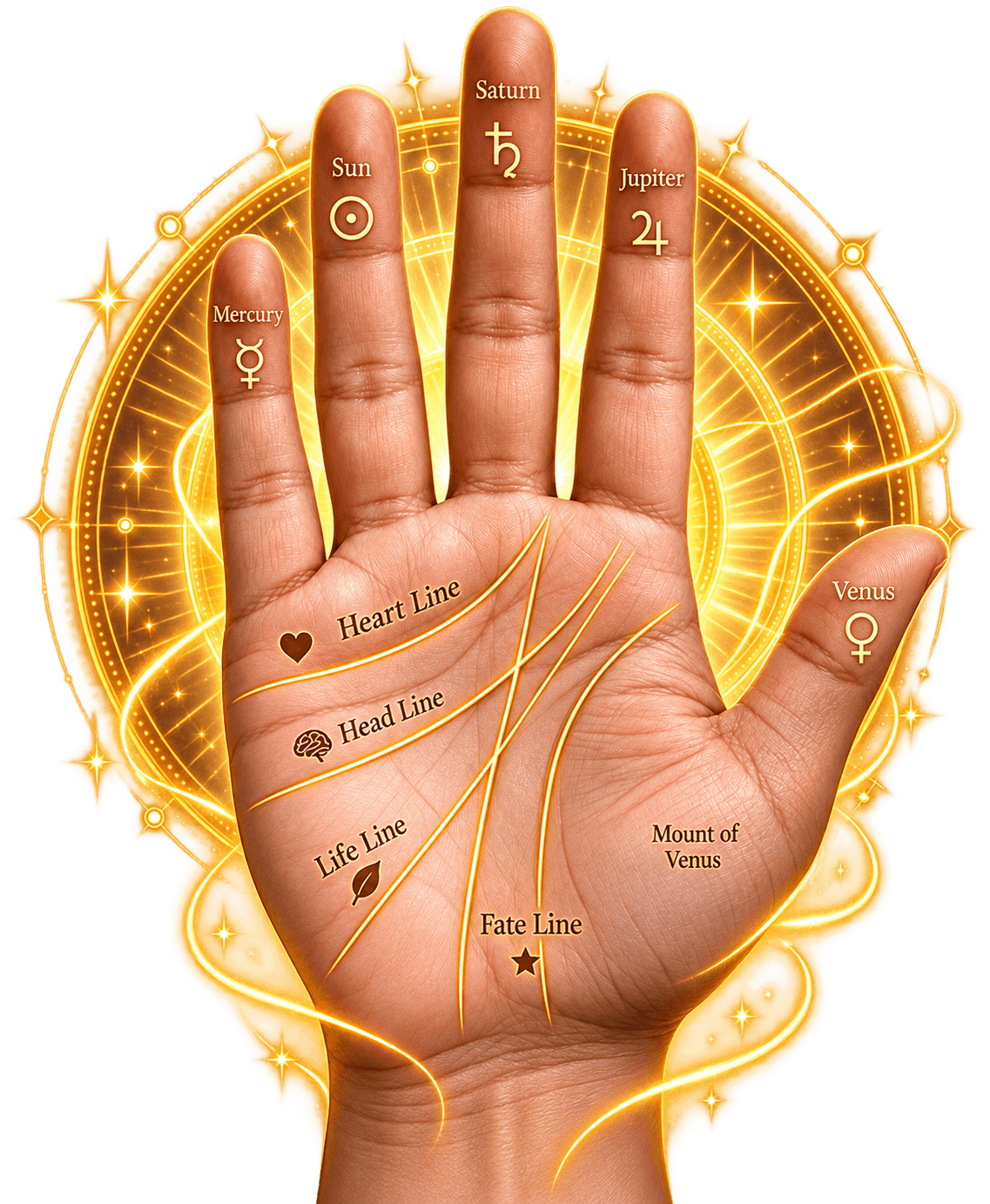
✦ Children line in palmistry
Children Line In Palmistry — The Santan Rekha On The Hand
अद्यतन 17 Oct 20266 मिनट पढ़ेंहस्तरेखा AI मुफ़्त और नियम-आधारित हस्तरेखा गाइड प्रकाशित करता है — हर पेज पहले शास्त्रीय अर्थ बताता है, फिर आपकी रोज़मर्रा की ज़िंदगी के लिए उसका मतलब।
छोटे में
The children line (santan rekha) is the set of fine vertical strokes on the outer edge of the palm below the little finger, standing on the marriage line like small posts. Classical Indian palmistry reads them for the chapters of parenthood — how many, the spacing, and the nature of each bond.
This is also the most misread line in popular palmistry. Old books count strokes and announce a number; modern honest readers do the opposite — they read the lines for pattern and mood, and say plainly that family size is not written on any hand as a guarantee.
Below: exactly where the lines sit, how classical counting works, why the boy-or-girl claim fails, the five common patterns and what each traditionally says about the parent-child bond.
Children lines are the fine vertical strokes standing on the marriage line, on the edge below the little finger. Count only the clear ones and read their length and depth.
संतान रेखा कहाँ होती है?
Turn the palm sideways and look at the edge below the little finger, just under the marriage line. Short vertical strokes rising from it are the children lines. On a photograph, zoom into that edge: they are among the finest marks on the hand and are usually invisible at arm's length.
Two cautions before you count. First, skin creases at the edge are not lines — a crease vanishes when you gently stretch the skin, a children line stays. Second, some hands show the pattern not on the marriage line but floating slightly above it; readers accept both, but never mix them with the marriage lines themselves.
कितने बच्चे होंगे? शास्त्र की गिनती असल में कैसी है
The classical rule is simple to state: stand the clear vertical strokes on the marriage line, count the distinct ones, and read the deepest stroke as the strongest bond. Traditional books then assign a number. The honest part usually gets left out: those same books were written before family planning, and every teacher worth listening to today treats the count as a tendency, never as a forecast of your family.
What the count is actually good for: seeing rhythm. Lines close together are read as children in a short span; lines that fade and restart suggest gaps due to career, health or personal timing. Neither pattern is better — they simply describe how the family chapter is paced.
बेटा या बेटी: संतान रेखा से लिंग नहीं तय होता
Many old books claim deep lines mean sons and light lines mean daughters. There is no reliable basis for this, and rivers of ink have been spilled on the contradictions: the same pattern is described differently by different schools. Any reader who confidently announces the gender of an unborn child from the hand is guessing, and you should say so.
What decent teachers do read instead: the quality of the bond. A long clear line is traditionally read as a child who stays close; a short deep one as a strong but independent nature; a forked or bent line as a bond with busy phases that always returns.
संतान रेखा के पाँच आम पैटर्न
Pattern reading is more useful than counting, because it speaks about relationships rather than arithmetic. These are the five forms classical reading describes, with the everyday meaning teachers attach to them.
Two clear lines
Traditionally read as two children or two strong child-figures in life, with different natures.
One deep, one faint
One close bond for sure; the faint line is read as a bond that may or may not grow into full form.
Very short strokes
Bonds that play out in short, bright chapters — guests, students, nephews and nieces.
Wavy line
An energetic, restless child is the traditional image — the parent's job is steady ground.
Line turning towards the palm
A child who returns home in phases; the bond leans on communication, not distance.
संतान रेखा और विवाह रेखा का रिश्ता
The children lines stand on the marriage line, so readers always read the pair: which life chapter does the child light up? A child line rising from the first marriage line is read as a bond from that chapter; lines that float between two marriage lines are read with more caution, and honest readers say the placement cannot answer questions the rest of the hand does not confirm.
Family-planning reality also matters in modern reading: adoption, chosen families and stepchildren all sit in these lines for contemporary readers, because the classical count never distinguished them. The bond is the subject; the biology is not.
एक मिनट में अपनी संतान रेखा पढ़ें
Photograph the outer edge in daylight, stretch the skin slightly, and zoom. Count only strokes that survive the stretch. Note their length, depth and where each stands on the marriage line. Then read the pattern into words — close-set or spaced, deep or light — and hold the count loosely.
A full AI palm reading reads the children lines together with the marriage line, the heart line and the family signs on the Venus mount, and presents the result as traits and tendencies with the honest caveat that no hand measures a family. Free, from one palm photo.
अक्सर पूछे जाने वाले सवाल
छोटे और सीधे जवाब — यही सवाल पाठक रोज़ पूछते हैं।
Where are children lines on the hand?
On the outer edge of the palm below the little finger, standing vertically on the marriage line. They are among the finest marks on the hand — photograph the edge in daylight, stretch the skin slightly and zoom, because skin creases vanish on stretching while real lines stay.
Can palmistry tell how many children I will have?
Traditional reading counts the clear strokes on the marriage line, but honest readers treat that as a tendency, not a forecast. Family size depends on health, choices and planning — things no line controls. Use the count to read the rhythm of the family chapter, never as a number you can rely on.
Can the children line tell if it will be a boy or a girl?
No. The claim that deep lines mean sons and light lines mean daughters has no reliable basis, and old books contradict each other on it. A reader who announces the gender of an unborn child from the palm is guessing. Palmistry is best used for the nature of the bond, not for biology.
What if there are no children lines on my palm?
It means the reading should not lean on these fine strokes at all. Plenty of parents have hands with no visible children lines, and plenty of people with clear lines choose not to have children. Readers then use the marriage line, the Venus mount and the whole hand to talk about family bonds.
Which hand should be read for children lines?
Read the active hand for what is happening in your family life now and the passive hand for the original pattern. Where the two agree, readers speak with more confidence; where they differ, they describe a change — usually a bond that has grown or a chapter that is still forming.
अपनी हथेली पढ़वानी है?
अपनी हथेली की फ़ोटो अपलोड करें और AI से मुफ़्त रीडिंग पाएँ — राशि, नक्षत्र और हाथ की हर प्रमुख रेखा, हिंदी और English में।
आगे पढ़ें
इसी विषय की चुनी हुई गाइड।
हस्तरेखा एक पारंपरिक विश्वास और मनोरंजन आधारित मार्गदर्शन है — इसे चिकित्सा, कानूनी या वित्तीय सलाह की जगह न लें।
Life line · Head line · Heart line · Fate line · Sun line · Money line · Marriage line · Health line · Children line