✦ Palmistry books in Hindi
Palmistry Books — A Reading List From Beginner To Deep
अद्यतन 17 Oct 20265 मिनट पढ़ेंहस्तरेखा AI मुफ़्त और नियम-आधारित हस्तरेखा गाइड प्रकाशित करता है — हर पेज पहले शास्त्रीय अर्थ बताता है, फिर आपकी रोज़मर्रा की ज़िंदगी के लिए उसका मतलब।
छोटे में
Palmistry books in Hindi and English split into two honest families: the classical Western manuals — Cheiro and Benham being the two names every teacher repeats — and the Indian hast samudrik shastra tradition, where mounts, signs and family readings are taught in the language of festivals, planets and households.
This page is deliberately not a 'top 10 with ratings' list. Nobody's store here, no invented reviews — just the titles that actually shaped the practice, what each one is good for, and the reading order that works for a self-taught student.
Read the list first, then read the last section: how a book plus free guide pages plus daily photo practice together beat any single shelf of tomes.
हस्तरेखा की किताबें कैसे चुनें
Three filters keep a beginner out of the market noise. First, prefer books that describe patterns rather than promising events — a serious manual talks about depth, direction and context, never about fixed dates. Second, prefer books with photographs or clear drawings: palmistry is learned with the eye.
Third, one book at a time. Collecting titles feels like progress and is not. A single thin classic, read with your own palm open beside it, teaches more than ten unopened volumes on the shelf.
English classics: Cheiro aur Benham
Count Louis Hamon, who wrote as Cheiro in the early 1900s, is the reason the world says 'palmistry' instead of 'chiromancy'. His book on the language of the hand is short, confident and still the friendliest first read: it maps the lines and mounts in plain sentences, and its confidence is also its flaw — Cheiro liked a decisive tone.
William G. Benham's Laws of Scientific Hand Reading (1900) is the opposite: thick, systematic, obsessed with defining every variation. Where Cheiro charms, Benham builds — and his book remains the reference serious students check against when two schools disagree about a line.
हिंदी की पारंपरिक किताबें: हस्त सामुद्रिक शास्त्र
The Hindi tradition is wider than the Western one and writes with the assumption that the reader lives in a joint family, runs a shop or fields, and asks about children, property and shubh muhurat. Samudrik shastra books usually combine the hand with the body, the face and the voice — the reader is expected to look at a whole person, not one palm.
Look for reprints of the classic hast samudrik texts rather than modern 'instant prediction' paperbacks. The classics explain mounts and signs in devotional language, and once you can translate that language into plain observation — Venus mount as family life, Mercury as trade and speech — the older books become the richer ones.
Free पढ़ाई: इस साइट की guides का order
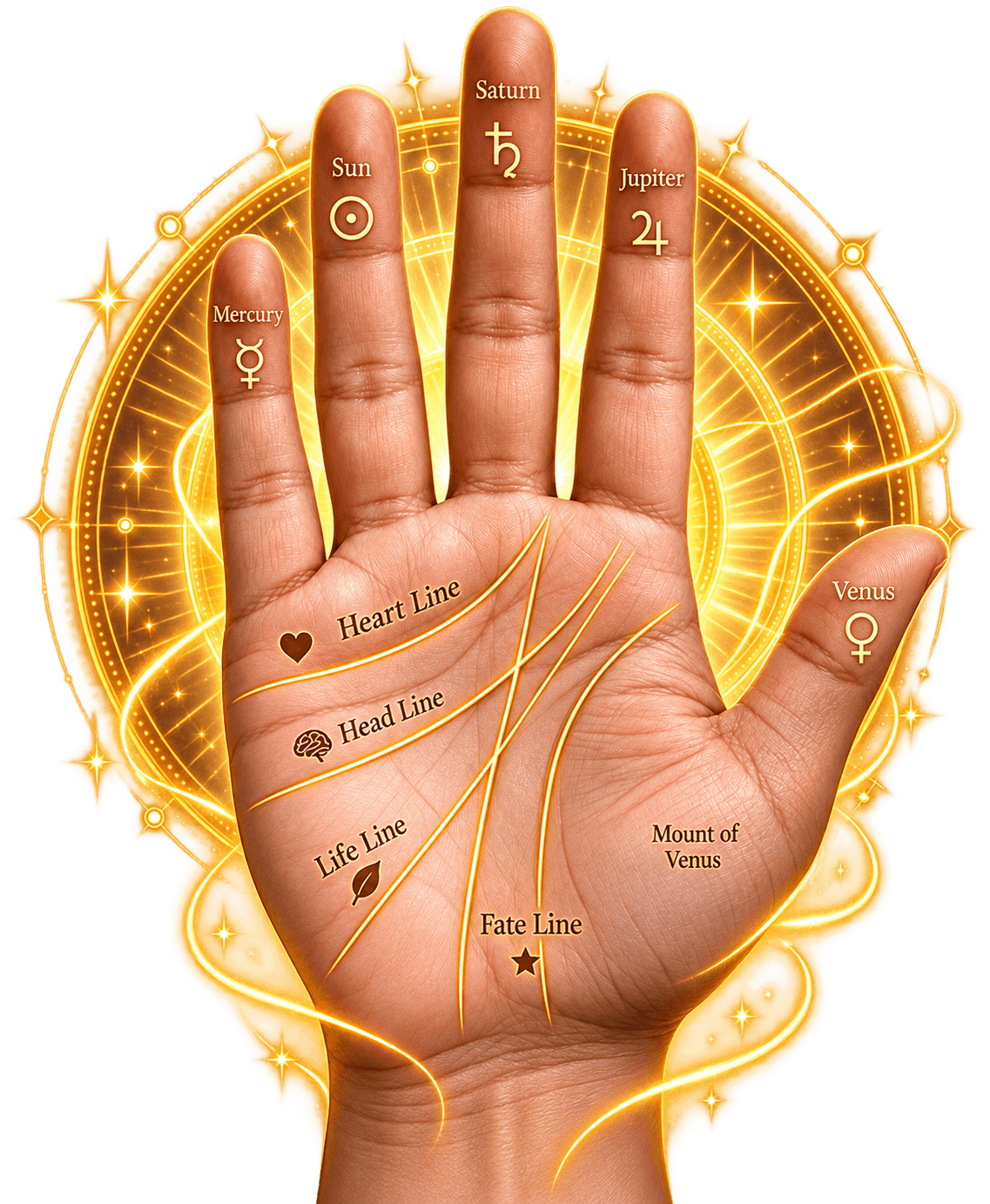
Before or beside any book, the free guides on this site follow the exact teaching order: the complete hast rekha palmistry guide for the full map, then one page per line, then the sign and comparison guides. Each page carries a diagram with the line highlighted, so the eye learns the geography while the mind learns the meaning.
Then close the loop with practice: upload one palm photo a day to the AI reading, write your own two-sentence verdict first, and compare with the report. A chapter of Cheiro is worth ten minutes; ten minutes of comparison is worth a chapter.
किताब क्यों काफ़ी नहीं है
A printed book can only show one hand: its author's idea of a hand. Your palm, your mother's palm, your colleague's palm are the real pages. Every reader who ever got good did it by looking at hundreds of live hands or photographs and being honestly wrong until the eye calibrated.
So the honest reading list has four items: one beginner classic, one thick reference, one Hindi shastra reprint, and the free guide series. Four resources, used daily, beat forty books bought once.
अक्सर पूछे जाने वाले सवाल
छोटे और सीधे जवाब — यही सवाल पाठक रोज़ पूछते हैं।
Which palmistry book should a beginner read first?
Cheiro's language-of-the-hand work is the friendliest first read — short, clear and confident about the basics. Read it with your own palm open and verify every line on your own hand. Keep a thicker reference like Benham nearby for later, and start this site's free guide series in parallel.
Who was Cheiro in palmistry?
Cheiro was the pen name of Count Louis Hamon, an Irish-American reader who wrote in the early 1900s for the public rather than for scholars. His books made palmistry mainstream in English, and his style — confident, story-driven, sometimes over-decisive — still shapes how popular palmistry is written today.
Are Hindi hast samudrik shastra books reliable?
The classical reprints are — they preserve the Indian reading of mounts, signs and family matters that Western books miss entirely. Judge them the way you judge any text: a good one describes patterns and context, a weak one promises fixed events. Prefer reprints of old texts over modern instant-prediction paperbacks.
Can I learn palmistry without buying any book?
Yes, and many good readers did. The free guides on this site follow the standard teaching order — full map first, then line by line, then signs and two-hand comparison. What no free path replaces is practice: hundreds of palm photos, your own reading written first, and honest comparison with a reference report.
How many palmistry books do I actually need?
Four resources cover a serious self-taught path: one beginner classic, one thick systematic reference, one Hindi shastra reprint, and a free guide series with diagrams. Everything beyond that is repetition with different covers. The scarce ingredient is not titles — it is hours spent looking at real palms.
अपनी हथेली पढ़वानी है?
अपनी हथेली की फ़ोटो अपलोड करें और AI से मुफ़्त रीडिंग पाएँ — राशि, नक्षत्र और हाथ की हर प्रमुख रेखा, हिंदी और English में।
आगे पढ़ें
इसी विषय की चुनी हुई गाइड।
हस्तरेखा एक पारंपरिक विश्वास और मनोरंजन आधारित मार्गदर्शन है — इसे चिकित्सा, कानूनी या वित्तीय सलाह की जगह न लें।
Life line · Head line · Heart line · Fate line · Sun line · Money line · Marriage line · Health line · Children line