
Videsh Yatra Yog: Palm Signs of Foreign Travel and Settlement
10 min read·16 November 2026
Videsh Yatra Yog is one of the most requested readings in India — a job abroad, a student visa, or a family settlement. Palmistry has a genuine travel signature, but it is a combination of marks, not a single line with an airplane drawn on it.
This guide covers the travel line on the percussion, the fate line's branches, the Moon mount, the influence of the 12th house and the practical truth: a palm can show restlessness and opportunity, but a visa is granted by an embassy, not by a crease.
Read your own palm with AI — start free
Upload one photo of your palm and get the core reading instantly in Hindi or English — no login and no card. The complete 12-area report, main-problem turning point, 5-year roadmap, partner report and printable PDF are in the one-time ₹101 Pro report.
1The Travel Line on the Percussion
On the outer edge of the palm, between the base of the little finger and the wrist, short horizontal lines are read as travel. A clear line that runs toward the Moon mount or crosses the fate line is the classic videsh yatra mark. Several fine lines often mean many short trips rather than one relocation.
Depth matters more than count. A deep, unbroken travel line suggests a journey that changes something — study, work, marriage. A faint or broken line often means the plan was discussed but postponed. Read it with the fate line, never alone.
2Fate Line Branches Toward the Moon
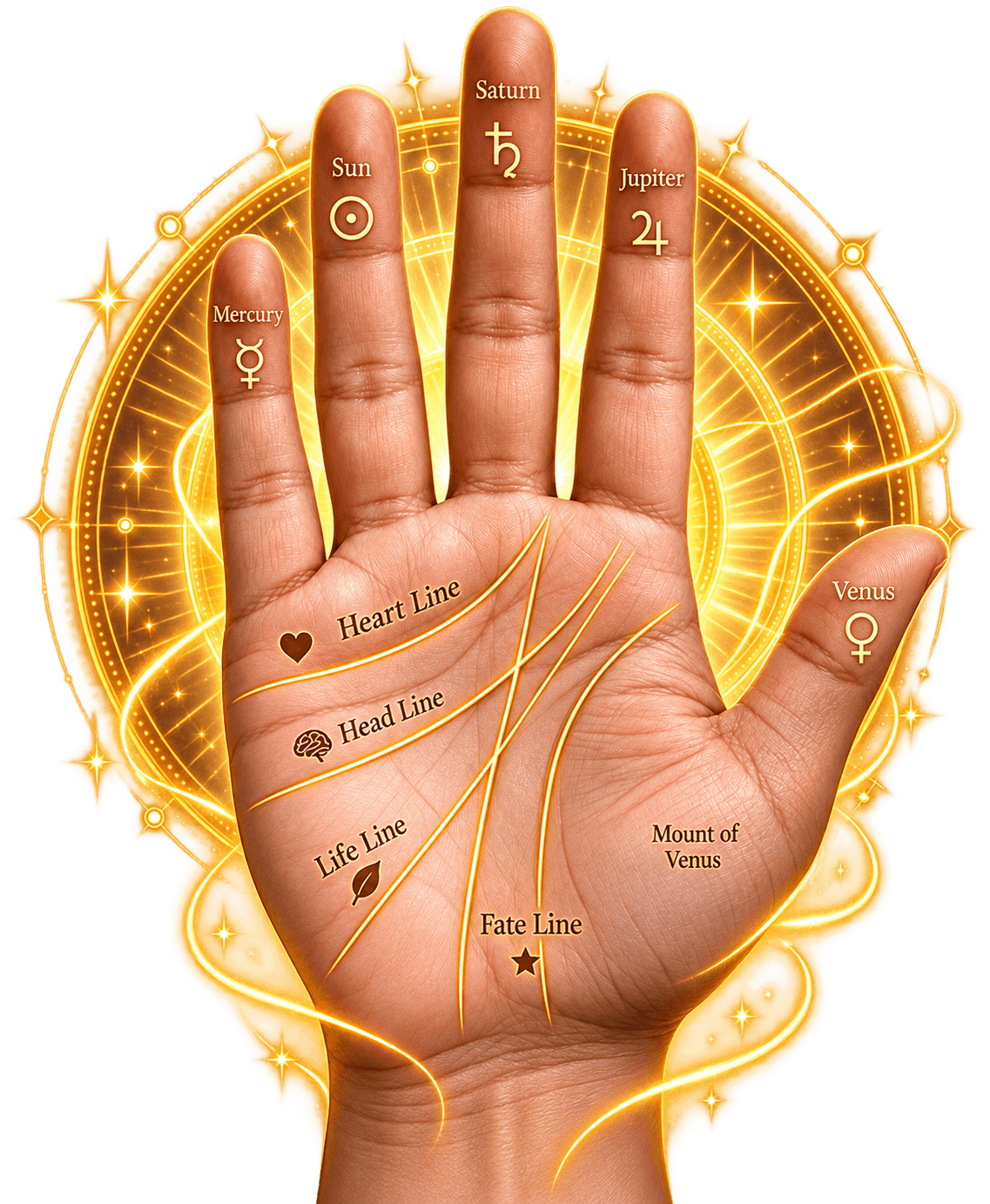
The fate line rising from the wrist can branch toward the Moon mount at the base of the palm. That branch is read as a career or life direction shaped by travel, water, foreign contact or public reach. If the branch is strong and the main fate line continues, the person often keeps both a home base and an international life.
A fate line that starts high, near the head line, and then moves outward often means the foreign move happens in the middle of a career rather than at the start. A fate line that begins at the wrist and leans out early points to study or a first job abroad.

3Moon Mount and the Water Signs
The Moon mount sits on the lower outer edge of the palm, opposite the thumb. A full, soft Moon mount belongs to an imaginative, mobile mind that adapts to new cultures. Classical palmistry links it to water, travel and the mother's side of the family — and often to a life near coasts or abroad.
A heavily lined Moon mount can mean restlessness and difficulty settling in one place. That is not a defect; it is a temperament that needs a portable career, remote work or a job that involves movement. The palm describes the appetite, not the ticket.
4The 12th House Connection
In the kundli, the 12th house rules foreign lands, long journeys, sleep and isolation. A strong 12th house, a connection between the 12th lord and the 9th or 10th, or Rahu in the 12th are the classical foreign-settlement combinations. The palm and the chart should agree before a reading becomes confident.
Rahu is the planet of crossing boundaries, so its involvement often shows a sudden or unconventional move rather than a planned family migration. Saturn's involvement shows a slow, bureaucratic process — paperwork, patience, and a move that finally happens after delays.
5Signs People Mistake for Travel
A fork on the life line is not a plane ticket. A cross on the Moon mount is not a visa. A 'travel line' that is actually a skin crease is extremely common. Social media often circles random marks and calls them videsh yog, which creates false hope and unnecessary expense.
The honest test is simple: does the mark appear on both a clear photo and in person, and does the kundli support it? If yes, treat it as a tendency that rewards preparation — language test, skills, savings. If no, do not let a crease decide your future.
Special tip
Read travel as a combination: percussion line + fate branch + Moon mount + 12th house. Then do the boring work — IELTS, skill, savings — because the palm shows the door, not the key.