Money Triangle in Palm: Location, Types and Meaning of a Break
9 min read·9 November 2026
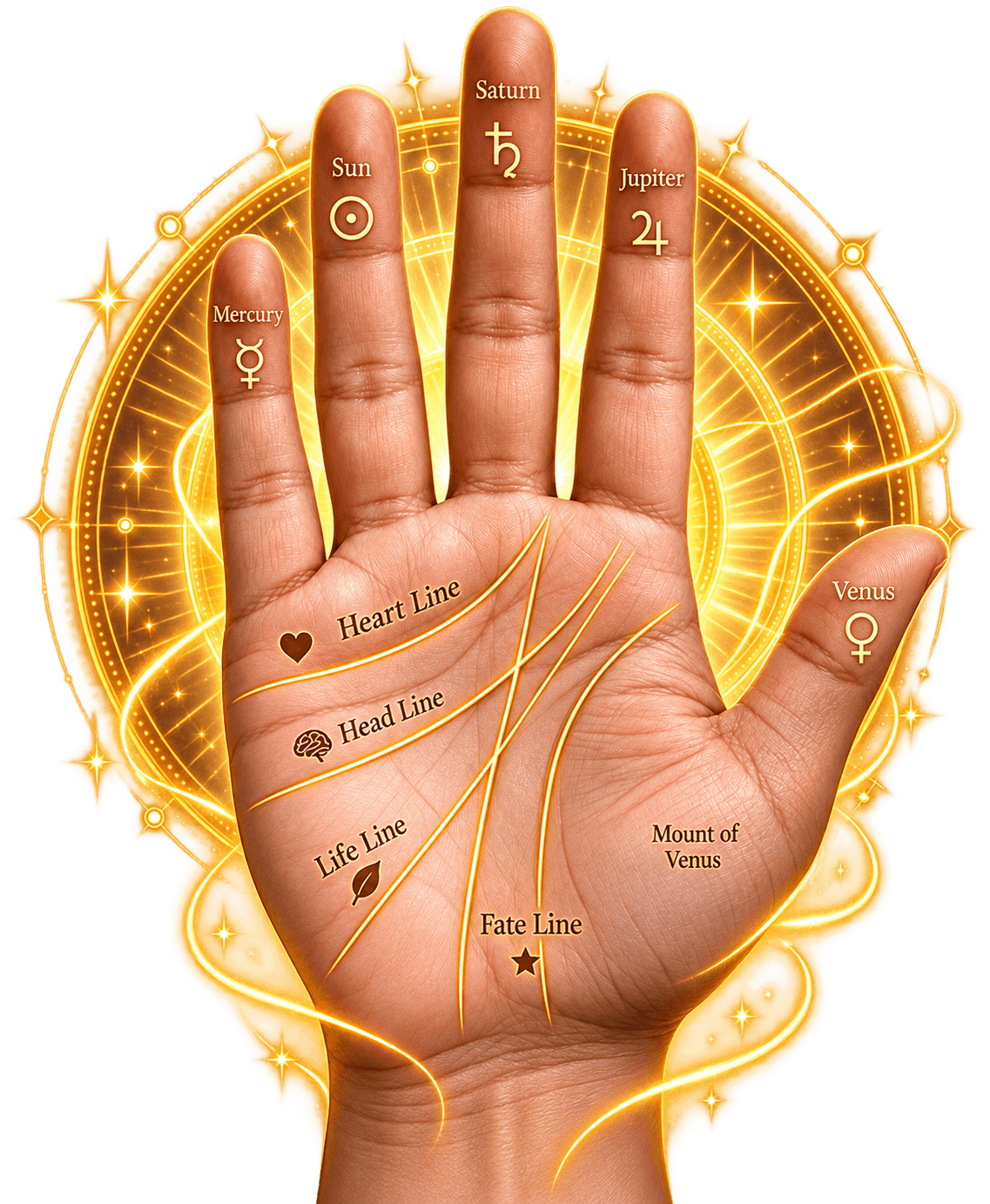
The money triangle is one of the few palm signs said to speak about money without relying on a single line. It forms where the life line, head line and fate line meet — the spot classical texts call the wealth corner.
But not every triangle is equal. A clear closed triangle, a broken one, and a double triangle tell different stories. Below: how to find it, what each type means, and which claims to treat with caution.
Read your own palm with AI — start free
Upload one photo of your palm and get the core reading instantly in Hindi or English — no login and no card. The complete 12-area report, main-problem turning point, 5-year roadmap, partner report and printable PDF are in the one-time ₹101 Pro report.
1Where the money triangle sits in the palm
Place your palm up and look at the centre-lower area, just below the head line. The triangle is formed when the head line and life line are joined by a third line, enclosing a small patch of skin. The shape is usually small — often no bigger than a fingernail — so good light matters.
If the third line is missing, there is no triangle — a gap is not a broken triangle. Read a break only when the connecting line exists but is interrupted.
2A clear, closed triangle
A closed triangle with unbroken sides is read as steady accumulation: money that stays, savings that grow, and a habit of planning rather than spending on impulse. The deeper and cleaner the sides, the stronger the classical reading.
This is a description of a money style, not a bank balance. A clear triangle cannot replace income or discipline.
3Broken or open triangle
When one side of the triangle is broken or open, readers say money flows through rather than staying — income may arrive but leaks into expenses, loans or sudden costs. In practice this is often read as a nudge to build an emergency fund, not as a curse.
A break near the fate line is read as a change in earning method; a break near the head line as a decision that resets the budget.
4Double money triangle
A double triangle — two small triangles sharing a side or sitting next to each other — is read as more than one income stream, or money that returns after a gap. It is a popular mark in online palmistry, so treat the excitement with care: two triangles are still just creases, not a contract.
Read the quality of both triangles: one strong and one faint usually means one steady stream and one uncertain one.
5Money triangle with the fate and sun lines
A triangle means more when it agrees with the rest of the hand. A strong fate line rising from the triangle suggests direction and steady work; a clear sun line adds recognition, and a deep money line adds business sense. Signs agreeing with each other is the strongest statement a palm can make.
If the triangle is clear but the fate line is broken, read it as potential without a stable route — the missing piece is a plan, not luck.
6Money triangle vs X mark vs star
The triangle is a closed shape made by three lines, the X is two lines crossing, and the star is many lines meeting at a point. Classical reading treats the triangle as the most stable of the three for money, the star as event-related, and the X as a lighter signal that depends entirely on its location.
Seeing all three together is rare; when it happens, readers read the triangle first, the star second, and the X last.
7Does the money triangle guarantee wealth?
No. The triangle describes a relationship with money — how it is kept, spent and grown — not a fixed amount. Income, skills, health and decisions still do the real work. Treat the mark as a prompt to review your savings, not as a prediction to wait on.
To see your triangle with the lines around it, take a free AI palm scan at hastrekhaai.online — the report shows the money area, fate line and sun line together.
Special tip
Palmistry is a traditional art, not financial advice. Savings, budgeting and professional guidance matter more than any sign.