How to Read Palm Lines with Photos: 7 Easy Steps
11 min read·9 November 2026
Most palmistry guides start with meanings. This one starts with the step everyone skips: taking a photo good enough to read. If the light is wrong or the fingers are curled, half the lines disappear and the reading becomes guesswork.
Follow the seven steps below and you will be able to locate the five main lines on your own hand, describe their quality, and know exactly what a beginner should not conclude.
Read your own palm with AI — start free
Upload one photo of your palm and get the core reading instantly in Hindi or English — no login and no card. The complete 12-area report, main-problem turning point, 5-year roadmap, partner report and printable PDF are in the one-time ₹101 Pro report.
1Step 1: Which hand should you read?
Use the active-hand rule: the hand you write with shows how you currently act, the other hand shows what you were born with and what feels natural. For most people that means the right hand is the active one, but left-handed readers simply reverse it. Gender does not decide the hand.
For comparison readings, photograph both palms in the same light. Differences between the two hands are often more useful than either hand alone.
2Step 2: Take a palm photo that is actually readable
Checklist: open the palm fully; keep fingers slightly apart; use daylight from a window, not a ceiling bulb; hold the phone parallel to the palm; and turn off beauty filters that smooth skin. A shadow across the centre hides the head and heart lines.
Take one wide photo and one close-up of the centre. The wide shot shows the overall shape and mounts; the close-up shows breaks and fine branches that decide the reading.
3Step 3: Locate the five main lines
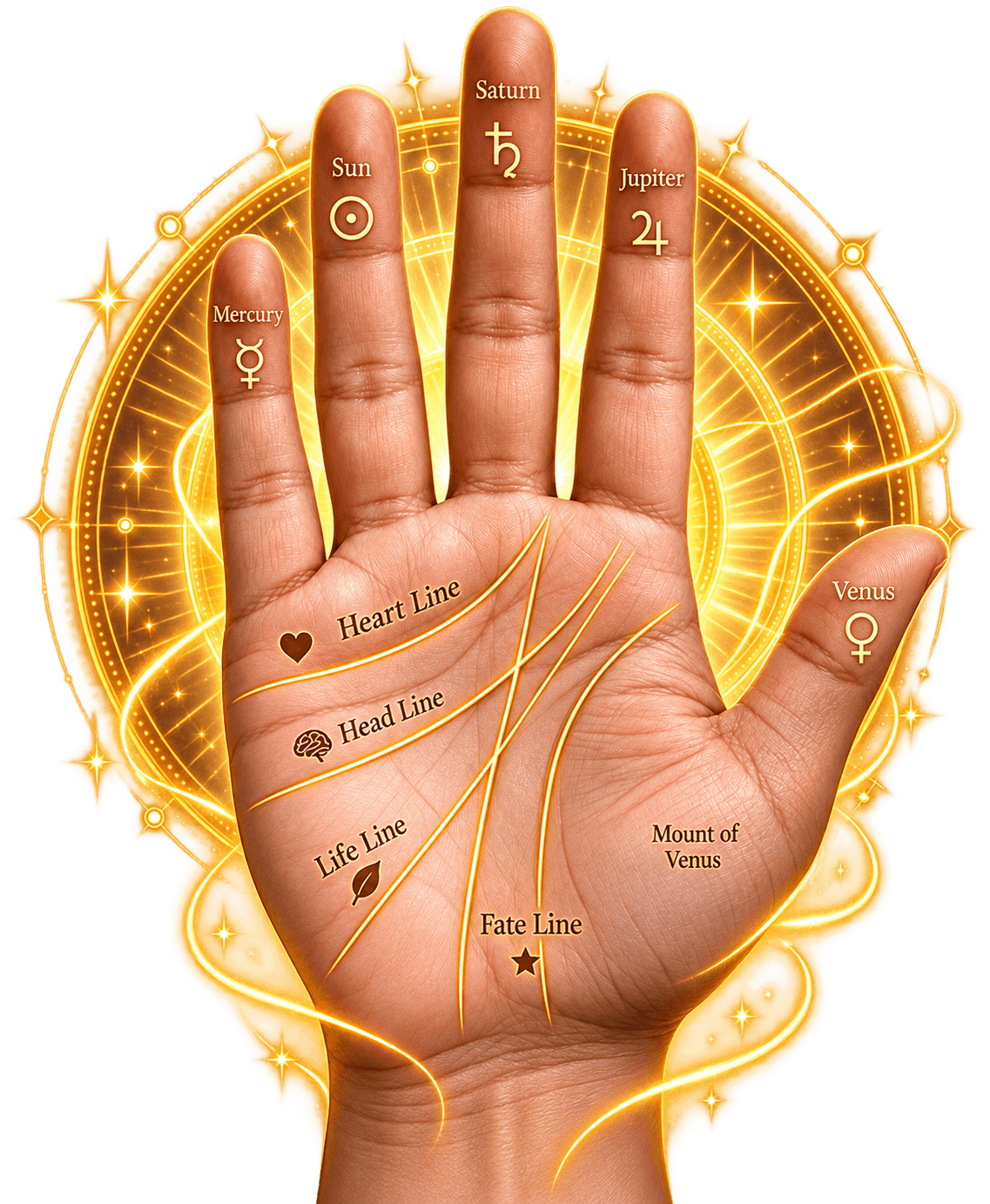
Life line: the curve around the thumb base, running towards the wrist. Head line: the horizontal line across the middle, usually starting near the life line. Heart line: the upper horizontal line below the fingers. Fate line: the vertical line rising towards the middle finger. Sun line: the vertical line under the ring finger.
Say the name out loud as you trace each one. Naming first, meaning second — this single habit prevents most beginner confusion.
4Step 4: Read depth, breaks and branches
A deep, unbroken line is read as steady energy in that area. A faint line as low energy or a quiet theme. A break marks a change of direction, not a disaster. A chain-like line (many small links) suggests scattered effort, and a branch shows an added direction — where it points matters more than the branch itself.
Write two sentences per line: what you see, and what you cannot yet tell. Honest notes beat confident guesses.
5Step 5: Why mounts matter
Mounts are the fleshy pads under each finger and along the palm edge. They tell you the ground a line sits on: a strong Jupiter mount adds ambition to a head line, a full Venus mount adds warmth to a heart line. A line without its mount is a sentence without context.
You do not need all seven mounts on day one. Learn Jupiter, Venus and Mercury first — they cover ambition, relationships and money.
6Step 6: The five mistakes beginners make
One: reading lifespan from the life line. Two: treating a break as death or illness. Three: panicking at an X or cross. Four: reading one hand only. Five: judging from a blurry photo. Every one of these turns a useful symbol into fear.
A line is a pattern of emphasis, not a medical report and not a fixed future.
7Step 7: Practise with an AI scanner, then verify
An AI palm scan is useful as a second pair of eyes: it marks the lines on the photo and gives you a structured description. Use it to practise identification, then check the result against what you can see yourself — never the other way round.
Ready to try? Upload a clear palm photo at hastrekhaai.online for a free AI reading and compare the marked lines with this guide.
Special tip
Take photos in daylight and read both hands. Palmistry is for reflection and entertainment, not medical or life decisions.