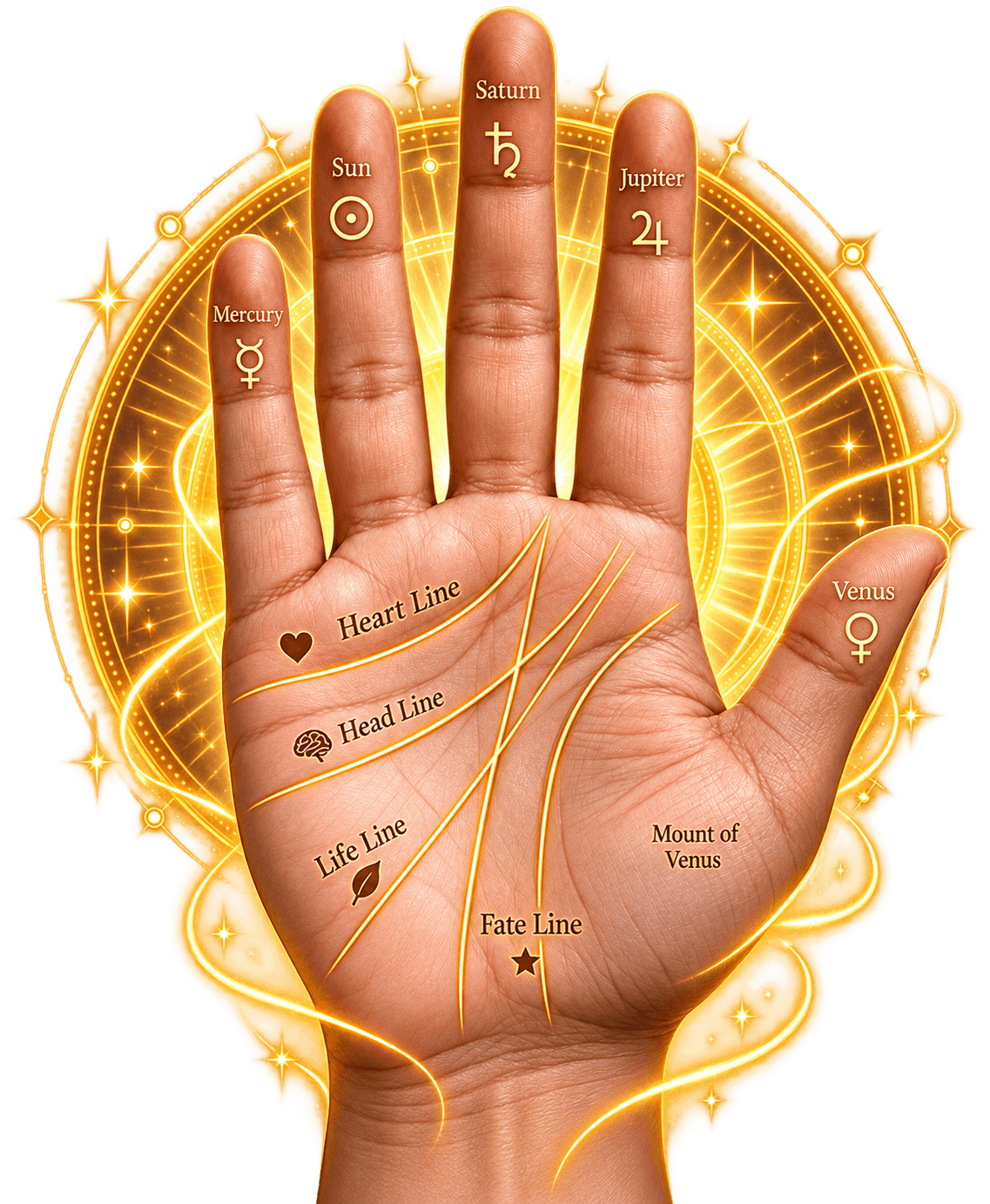

Education Line in Palm: Signs of Study, Degrees and Skill
10 min read·14 November 2026
Parents often ask whether the palm shows a doctor, an engineer or a failure. The honest answer is that the palm shows how a child learns — pace, focus, support needs — not a fixed profession. The education line is one of the clearest places to read that learning style.
This guide covers the vidya rekha under the fingers, the Mercury line's role in learning, the difference between education and career lines, and the marks that suggest a non-linear path — skill-based, creative or self-taught.
Read your own palm with AI — start free
Upload one photo of your palm and get the core reading instantly in Hindi or English — no login and no card. The complete 12-area report, main-problem turning point, 5-year roadmap, partner report and printable PDF are in the one-time ₹101 Pro report.
1Where the Education Line Is
The education line is usually read as a small line rising from the head line toward the Mercury mount, or as a branch from the fate line toward the index finger. Some palmists also read the vertical lines under the little finger as study marks. Position varies, so use good light and compare both hands.
A clear, unbroken education line suggests steady study and the ability to finish a long course. A deep line that reaches Mercury suggests strong communication, commerce or analytical ability. A line that fades halfway often means the formal course lost momentum but learning continued elsewhere.
2Education Line vs Fate Line
The fate line is vertical, rising from the wrist toward the middle finger; it tracks career direction and responsibility. The education line is shorter and more horizontal, sitting in the upper half of the palm. Beginners confuse the two because both can point toward the fingers.
Read them together: a strong education line with a weak fate line often means excellent learning that takes time to convert into a career. A strong fate line with a weak education line often means early work experience teaches more than college. Neither is failure.

3The Mercury Line and Learning
Mercury rules memory, speech, calculation and trade. A clear Mercury line supports quick learning, good notes and the ability to explain what you know. A chained Mercury line can mean anxiety around exams rather than low intelligence — the knowledge is there, but performance fluctuates.
For a student with this pattern, the fix is practical: mock tests, sleep, writing practice and a calm exam routine. A palm reading that says 'kamzor Budh hai, path padhao' without addressing exam anxiety is selling fear, not guidance.
4A Broken or Faint Study Line
A broken education line does not mean a broken future. It often shows an interruption — a change of stream, a gap year, a course that was abandoned — followed by learning in a different form. Many successful professionals have exactly this mark.
If the line restarts and deepens after the break, the reading is positive: the person found their real subject. If it stays faint, the advice is to build skill through practice, mentorship and short certifications rather than a long formal degree.
5Reading a Child's Hand Responsibly
Children's hands change rapidly, so a reading should never be used to label a child as 'weak in studies' or 'not college material'. Use it to identify support needs: more structure, more movement, more visual learning, or a teacher who explains verbally.
The palm is a mirror of temperament, and temperament can be trained. A faint line today can deepen with practice, and a strong line can fade with neglect. That is the most hopeful — and most accurate — thing palmistry says about education.
Special tip
Read the education line with the head line, Mercury line and fate line. Then ask the practical question: what kind of support does this learner need? That answer changes results more than any prediction.